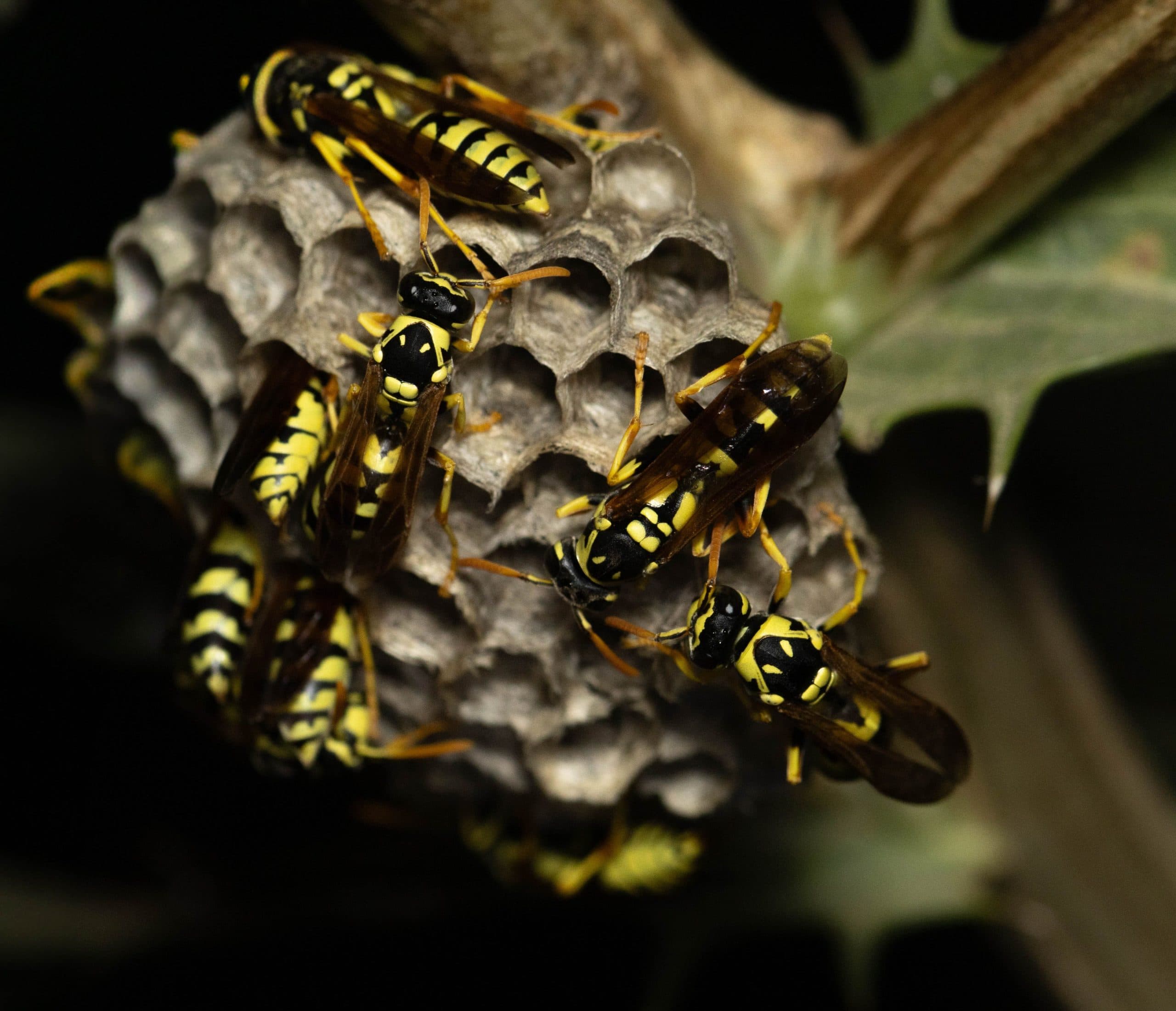
A wasp nest hidden above your ceiling can start with one queen and a paper structure around the size of a golf ball.
At first, she does everything herself. She builds the first cells, lays the eggs and feeds the larvae. Once the first workers emerge, the pace changes. They take over the foraging and construction while the queen concentrates on producing more offspring.
That is how a small spring nest can become a busy summer colony without anyone seeing the early development. The loft or wall did not create the problem. It gave the queen the dry, protected space and outside access she needed to begin.
This article by Clear Pest Control explains why wasps choose lofts, walls and underground spaces, how a nest develops and what repeated flight activity can reveal when the paper structure itself remains hidden.
Why Wasps Choose Lofts, Walls and Cavities

A queen does not need food waiting beside the nest. She needs somewhere sheltered enough to raise her first brood without the developing paper structure being exposed to rain or regular disturbance.
The Natural History Museum explains that social species look for dry, safe and structurally sound nesting sites. These can include natural hollows, underground spaces and parts of buildings.[2]
A wasp nest may therefore develop inside a roof void, wall cavity or outbuilding while the workers forage elsewhere.
The nest site is the nursery, not the food source. There does not need to be anything edible inside the loft or wall to make that space suitable.
How a Wasp Nest Starts
The start of a wasp nest is easy to miss because the colony is tiny and the queen is doing all the work alone.
An overwintered queen becomes active in spring and searches for a protected site. She scrapes wood fibres, mixes them with saliva and turns them into the grey, papery material used for the first cells.
Cherwell District Council describes an early nest as roughly the size of a golf ball. The queen may initially lay around 10 to 20 eggs, although many early nests never develop into established colonies. [3]
In an early stage wasp nest in loft, there may be little more than a small paper structure and one queen coming and going. At that point, there may not be enough traffic to make the nest obvious from outside.
How a Small Wasp Nest Grows
The real change begins when the first workers emerge.
Before that point, the queen is building, foraging and feeding the larvae herself. The Natural History Museum explains that the workers eventually take over the collection of materials, food gathering and expansion of the nest. The queen can then concentrate on laying eggs. [2]
A small wasp nest can therefore grow much faster once it has a working population. BPCA says an established colony can contain thousands of individuals during peak summer activity.[1]
This is why a small external opening does not prove the nest behind it is small. A substantial colony can develop inside a roof or wall while the only visible clue is a stream of workers using one narrow gap.
The Seasonal UK Wasp Nest
A typical UK wasp nest is seasonal.
Queens emerge in spring and begin new nests rather than returning to the old paper structure. The workers appear later and the colony grows through summer.
Towards the end of the season, new queens and males are produced. The new queens leave to find sheltered overwintering sites, while the workers, males and original queen die.
The old nest is not normally reused. The RHS explains that wasp colonies die out in late summer or autumn, although the empty paper nest can remain physically present for much longer. [4]
An old nest can still be above the ceiling. That does not mean the old colony is still alive.
Why Wasps Build Nests in Lofts

A wasp nest in loft spaces is usually there because the roof provides shelter, suitable attachment points and easy access to the outside.
A queen may enter beneath a roof tile or through a gap near the soffit. The entrance can look very small compared with the protected space available once she reaches the loft.
Repeated activity around one section of the roofline is often the first reliable clue. Wasps may disappear beneath a tile or behind a fascia without entering the occupied rooms below.
For wasp removal Newcastle upon Tyne, the safest starting point is often to trace that outside flight route. Entering a loft blindly or moving insulation around a suspected nest can disturb the colony and increase the risk of multiple stings.
What a Wasp Nest in a Wall Looks Like
With a wasp nest in wall, you often find the entrance before you find the paper nest.
Workers may enter through a brickwork gap or another weakness in the exterior before travelling farther into the cavity. The nest itself may sit some distance from the visible opening.
Several wasps repeatedly entering exactly the same point are more useful than one insect investigating the wall. Buzzing from behind plasterboard can support the suspicion, especially when it matches activity outside.
Do not seal the entrance while the colony is active. Wasps trapped inside the cavity may begin searching for another way out, potentially pushing activity towards occupied rooms.
For wasp nest removal Gateshead enquiries involving a hidden wall cavity, the visible hole should be treated as an access route rather than proof of the nest’s exact position.
Wasp Nest in House Cavities
A wasp nest in house cavities may remain unnoticed until worker numbers increase or wasps begin appearing indoors.
The nest could be above the ceiling or deeper inside a wall void. Wasps entering a room do not always mean the paper structure is immediately behind the nearest surface. They may be following light, warmth or an alternative route from the cavity.
Look for a connection between indoor sightings and external activity. If wasps appear near one window while a steady flight path is visible around the roofline outside, both signs may relate to the same hidden colony.
Rooflines can attract other species as well, and birds nesting around rooflines may use sheltered gaps, eaves and other protected areas around a building.
Do not start opening the wall or ceiling to confirm it. The safer approach is to trace the established entry point from outside and assess where that route is likely to lead.
Wasp Nests in the Ground
Some common social wasps build below ground rather than inside buildings.
A wasp nest in ground areas usually develops inside an existing cavity. The opening may be little more than a small hole, while the paper nest sits farther beneath the surface.
An underground wasp nest can be difficult to notice until gardening, mowing or regular foot traffic disturbs it. The RHS warns that wasps may defend a nest when nearby soil, rough grass or planting areas are disturbed. [4]
Do not judge the nest by the size of the hole. Judge it by the traffic using it.
Repeated workers dropping into the same opening and emerging along the same route are a far stronger sign than one wasp hovering over the lawn.
How to Tell if a Wasp Nest Is Active

A paper nest can remain in place after the colony has gone, so finding the structure does not automatically mean active wasps are still inside.
The clearest sign is repeated two-way traffic through one exact point.
Cherwell District Council describes workers regularly entering and emerging from a particular place as the most reliable indication of a wasp nest. The traffic generally becomes more obvious as the colony grows. [3]
A steady stream of wasps disappearing into a wall, soffit or ground opening is more meaningful than several insects feeding around flowers.
For wasp control Sunderland cases involving regular roofline or wall activity, tracing that repeated route should come before anything around the cavity is disturbed.
How to Find a Wasp Nest
If the nest is hidden, trying to locate the paper structure itself may be the wrong starting point.
To understand how to find a wasp nest, watch the workers from a safe distance and identify where returning wasps disappear.
A flight line ending at a soffit may point towards a roof-space nest. Activity focused on a brickwork gap may suggest a wall cavity. Wasps repeatedly dropping into one section of ground may be using a nest below the surface.
BPCA advises carefully following worker wasps back towards their nesting site. [1]
Do not climb into an active loft, move insulation or begin opening a wall simply to see the nest more clearly.
Follow the traffic. Do not follow one individual wasp into an unsafe space.
Clear Pest Control pest advice focuses on the repeated route, likely cavity and risk around the entrance rather than assuming every wasp seen near the property belongs to a nest inside it.
Should I Get Rid of a Ground Wasp Nest in South Tyneside?
The position of the nest matters more than the postcode.
A ground nest well away from people and unlikely to be disturbed may be left until the colony dies naturally later in the season. Both BPCA and the RHS advise leaving wasp nests alone where they do not present a risk. [1] [4]
The answer changes when the nest sits beside a doorway or path, beneath a regularly used lawn or close to an area where children or pets spend time.
If the question is should i get rid of a ground wasp nest in South Tyneside, consider how easily someone could step on, mow over or otherwise disturb the entrance.
A nest close to daily activity presents a different risk from one in an unused part of the garden. Assessing the location, activity and potential risk around a pest problem is part of how our experienced team approaches pest control across the North East.
Can You Leave a Loft or Wall Nest Alone?
Sometimes, but access and location still matter.
A nest in an isolated part of an outbuilding may be able to remain until the colony dies naturally. A nest adjoining occupied rooms or sending workers indoors deserves closer attention.
Not every nest around a building will belong to wasps either. Bee nests around homes can require a different approach, which is why identifying the insect should come before deciding what to do.
The presence of someone with a known severe allergy also changes the risk. The NHS states that insect stings can cause anaphylaxis, a life-threatening allergic reaction requiring immediate medical help. [5]
Call 999 if someone develops signs such as difficulty breathing, swelling of the mouth or throat, confusion or fainting after a sting.
Where normal use of the property regularly crosses the nest route, leaving it alone becomes harder to justify.
Should You Seal a Wasp Nest Entrance?

Not while the nest is active.
Blocking the entrance does not remove the colony. It can trap workers inside the cavity and encourage them to look for another route.
That risk is particularly relevant when the nest is inside a wall or roof space adjoining occupied rooms. An alternative route may lead farther into the building rather than back outside.
The entrance can be proofed after the colony has been dealt with and activity has ended. Before then, it should be treated as part of an active flight route.
The appropriate response can also depend on where the colony has developed and the stage of the season. Our guide to wasp nest types and locations explains the common places nests appear across UK properties and why early-season activity can matter.
When a Hidden Wasp Nest Needs Professional Help
Professional assessment becomes more useful when the entrance is visible but the nest cannot be safely reached.
That often applies to wall cavities, roof spaces and underground nests beside regularly used areas. Professional help is also sensible when wasps are entering occupied rooms or the people living there face a heightened sting risk.
Someone searching for wasps control near me is often trying to answer one practical question: can the nest safely be left alone, or does its position make treatment necessary?
Clear Pest Control wasp removal can assess the flight path, likely nest position and level of activity before deciding what treatment is appropriate.
Contact Clear Pest Control when workers are repeatedly disappearing into a wall, roof space or ground opening and the nest cannot be safely assessed.
FAQs
Can One Queen Start a Wasp Nest?
Yes. A new social wasp colony begins with one overwintered queen.
She builds the first cells, lays the first eggs and raises the first brood herself. Once the workers emerge, they take over much of the construction and foraging.
How Fast Does a Wasp Nest Grow?
Growth is slower while the queen is working alone. It becomes much faster once the first workers emerge.
An established nest can contain thousands of wasps during peak summer activity, depending on its species and conditions. [1]
Will Wasps Reuse an Old Nest?
Normally, no.
The colony dies towards the end of the season. New queens leave to overwinter and build fresh nests the following year rather than restarting the old paper structure.
Can a Wasp Nest Be Inside a Wall?
Yes.
Wasps can enter through an outside gap and build deeper inside the cavity. The visible entrance may be some distance from the paper nest.
Why Is There a Wasp Nest in My Loft?
A loft gives the queen shelter from weather, suitable surfaces for attaching the nest and access through gaps around the roofline.
There does not need to be a food source inside the loft because the workers leave the property to forage.
How Do You Tell if a Wasp Nest Is Active?
Watch for repeated wasps entering and leaving the same point.
Regular two-way worker traffic is a stronger sign than simply finding an old paper nest or seeing one wasp nearby.
Should You Seal a Wasp Nest Entrance?
Not while the nest is active.
Blocking the normal route can force workers to search for another exit, which may direct them into the property.
Can Wasps Nest Underground?
Yes.
Common UK social wasps can use protected underground cavities. The entrance may look small even when a larger nest sits beneath the surface.
Does a Small Wasp Nest Mean It Is New?
Often, but not always.
A genuinely early nest may be small and quiet. However, a small visible opening in a wall or roof does not show how large the hidden nest is.
Why Do Wasps Keep Going Into the Same Hole?
Repeated use of one opening usually means it forms part of a regular route to a nest.
Workers learn the entrance and continue using it as they leave to forage and return to the colony.
Sources
[1] British Pest Control Association — Pest Advice for Controlling Wasps
[2] Natural History Museum — Why Do Wasps Build Nests?
[3] Cherwell District Council — Pest Control Advice: Wasps