You can have fleas in a house long after the animal that brought them in has gone.
A female cat flea can begin laying eggs only one to two days after its first blood meal. Those eggs are tiny, around 0.5 mm, and they do not remain attached to the pet. They fall into carpets, bedding and the places where the animal rests. Later in the lifecycle, a developed flea can remain protected inside its cocoon for months, waiting for the right conditions to emerge.
That is why a house can seem flea-free while empty, then suddenly produce jumping adults after someone moves in, returns from holiday or starts walking through the rooms again.
The pet may have left. The flea lifecycle may not have.
This article by Clear Pest Control explains where these insects come from, whether they can survive without pets, how the different life stages spread around a home and what to look for when the original host is no longer obvious.
Where Do Fleas Come From?

The answer to where do fleas come from usually begins with an animal host.
In UK homes, the most common flea pest is the cat flea. Despite its name, the cat flea can live on both cats and dogs. Adult fleas feed on the animal, but their eggs fall into the surrounding environment.
A current pet is the obvious route, but not the only one. Other possible routes include:
- An animal that previously lived in the property.
- A visiting cat or dog.
- Rodents or other animals associated with the building.
- Clothing or belongings exposed to an infested home.
- Soft furnishings carrying flea stages.
Activity from mice entering the property can also matter, as rodents may introduce fleas into areas such as wall voids, lofts and other sheltered spaces.
A previous pet can matter months after it has gone. Eggs may already have fallen into its sleeping areas, while larvae and pupae continue developing away from the animal. Around 95% of flea eggs, larvae and pupae are found in the environment rather than on the pet itself. [4]
The animal usually introduces the adult flea. The house can then support much of the next generation on its own.
Can Fleas Survive Without Pets?
The answer to can fleas survive without pets is yes, but the lifecycle stage matters.
Adults normally rely on a host for blood. Eggs, larvae and pupae develop away from the animal.
Eggs
Females lay their eggs while feeding on a host.
The eggs are not attached firmly to the animal’s fur, so they fall into bedding, carpets and surrounding floor areas as the animal moves. [1]
Larvae
The eggs hatch into larvae away from the animal.
Flea larvae avoid light and move deeper into carpet fibres or other protected areas. They feed on organic material, including dried blood found in adult flea faeces.
Pupae
The larva eventually forms a protective cocoon.
A developed flea can remain inside this cocoon for several months if temperature and other conditions are not suitable for emergence. [1]
Adults
Movement, warmth and carbon dioxide can signal that a potential host is nearby. The adult then emerges and begins searching for a blood meal.
So, can the infestation survive after the pet has gone?
Yes. Removing the animal does not instantly remove the eggs, larvae and pupae already spread through the home.
The Flea Lifecycle Explains Why They Keep Returning
It is easy to think every new adult must have entered the property recently.
Often, it developed there.
ESCCAP guidance explains that the complete flea lifecycle can take as little as 12 to 14 days in favourable conditions but may extend to around 350 days when development is slowed by temperature and humidity. [2]
That difference makes flea activity difficult to date.
One home may move through the lifecycle quickly in warm conditions. Another can hold protected pupae for a long period before adults begin emerging.
This is also why removing the adult you see does not reveal how many developing stages remain elsewhere.
The jumping flea is the visible stage. Most of the lifecycle has already happened out of sight.
How Do Fleas Get in Your House?

If you are asking how do fleas get in your house, pets remain the most common answer. Fleas do not, however, require your own cat or dog to start a problem.
They may arrive through a pet that currently lives in the home or remain from an animal that lived there previously. Visiting animals and rodents can also provide hosts.
BPCA notes that fleas may occasionally be transported on people, including on clothing, skin or hair after exposure to an infested environment. [4]
The route matters because it tells you what to investigate.
If the problem began after moving into a previously occupied property, environmental stages may have been left behind. If activity is concentrated around an old armchair or one bedroom, look at the history of that particular area rather than assuming the problem started at the nearest door.
How Do Indoor Cats Get Fleas?
An indoor cat does not live in a sealed environment.
Cats Protection explains these insects can be carried indoors on clothing. Visitors or other pets can introduce them, while environmental stages may already be present in carpets or soft furnishings.[3]
Rodent activity around a building can provide another route.
The important distinction is simple:
“Indoor cat” describes the cat’s routine. It does not mean the home is closed to fleas.
Once an adult flea reaches the cat, it gains access to the blood meal needed to reproduce. Eggs can then begin falling into the animal’s sleeping and resting areas.
That is why the answer to how do indoor cats get fleas often lies in the home itself rather than anything the cat has done outside.
Where Do Fleas Live?
Adult cat fleas normally live and feed on the host.
The developing infestation is spread more widely. Eggs, larvae and pupae tend to accumulate around the places where the animal spends the most time.
That can include pet bedding, carpets, rugs and upholstered furniture. ESCCAP explains that environmental flea stages are commonly found in the areas where infested pets rest. [1]
This means the answer to where do fleas live changes with the lifecycle stage.
A cat that sleeps on one chair for hours each day may deposit far more eggs around that chair than in a spare room it never enters. The same applies to a dog resting on a particular rug.
Do not only ask where the fleas live. Ask where the host spends its time.
Where Do Fleas Lay Eggs?
The adult flea usually lays its eggs on the host.
That often surprises people because most of those eggs later end up around the house.
A female cat flea can begin laying eggs within one or two days of its first blood meal. The smooth eggs are not firmly attached to the animal’s hairs, so normal movement allows them to fall away. [1]
A sleeping animal therefore distributes eggs around its bedding and nearby floor. A pet moving between rooms can spread them more widely.
Fleas lay their eggs on the animal. Gravity helps distribute them through the home.
That is why pet-resting areas should be among the first places inspected when tracing an environmental infestation.
Can Fleas Live in Carpet?
Carpet can support important parts of the flea lifecycle.
Adult fleas prefer to feed on a host, but eggs can fall between carpet fibres. The larvae avoid light and may develop deeper in the carpet, beneath furniture or around protected room edges.
They may eventually form cocoons in the same areas. [1]
That is why the answer to can fleas live in carpet is not simply about adult insects. A carpet can support eggs, larvae, cocoons and newly emerging adults.
The animal feeds the adult. The carpet can support the next generation.
The same principle applies to rugs, floorboard gaps and upholstered furniture around an animal’s resting area.
Can Fleas Live on Clothes?

Fleas can end up on clothing, but ordinary clothes are not the main long-term home of adult cat fleas.
An adult may travel briefly on a person or garment. Clothing exposed to an infested environment can also help move fleas between properties.
BPCA advises washing bedding, blankets, sofa covers and clothing that may have been affected during preparation for flea treatment. [4]
That does not mean domestic cat fleas normally establish a permanent population living on the clothes someone is wearing.
If activity follows you from room to room, consider whether fleas are jumping from carpet or furniture rather than assuming they are continuously living on your clothing.
What Do Fleas Look Like?
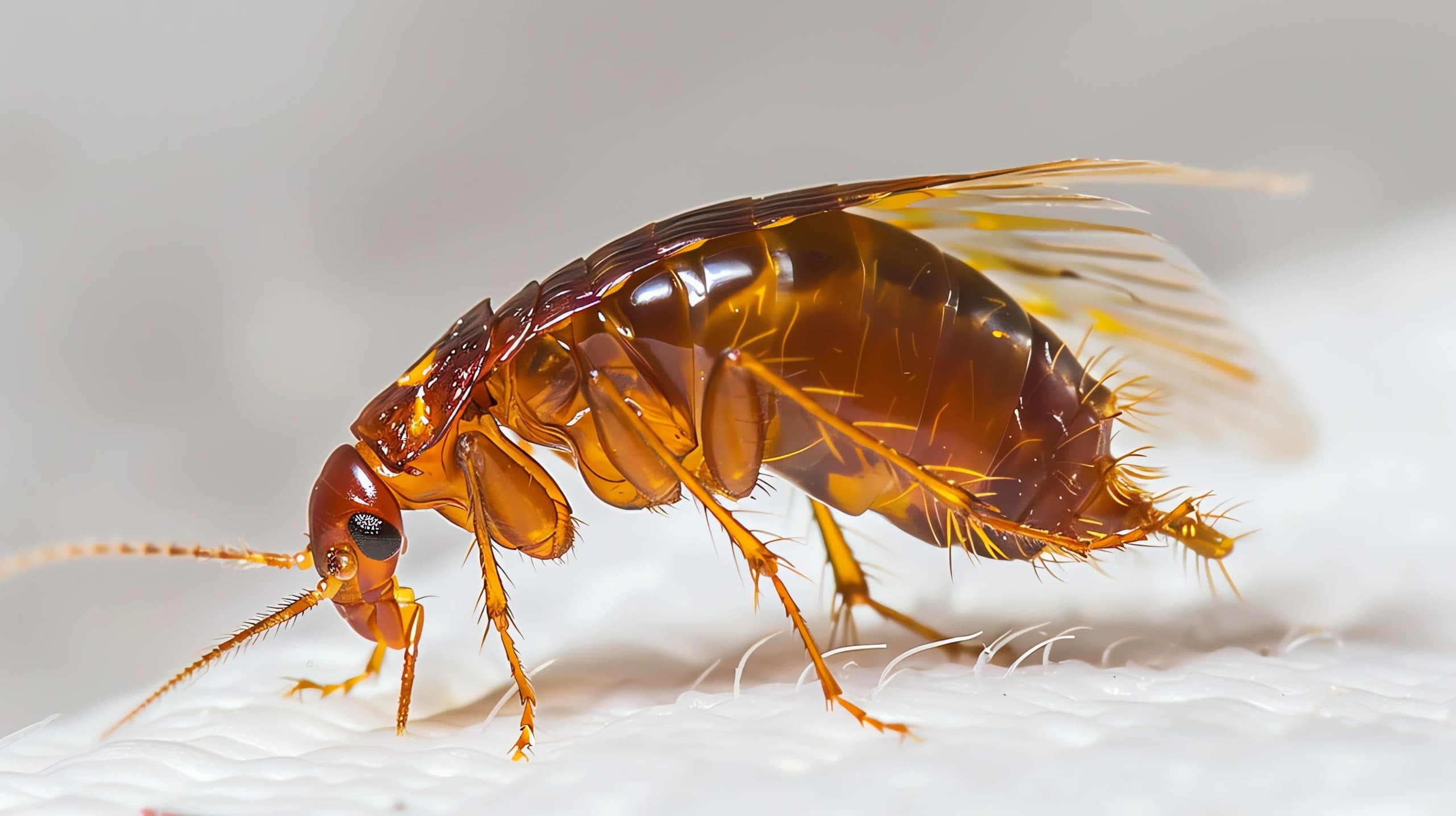
Adult cat fleas are small, wingless insects with a glossy brown appearance.
They are flattened from side to side, which helps them move through animal fur. Their powerful back legs are adapted for jumping.
ESCCAP places adult cat fleas at roughly 1.5 to 4 mm long. [1]
Think small and narrow rather than round like a beetle.
Because they move quickly and disappear into fur or carpet, the first view may be little more than a dark speck that suddenly jumps.
That is why the answer to what do fleas look like should include their movement and surrounding evidence, not only their colour.
How Big Are Fleas?
Adult fleas are only a few millimetres long.
At approximately 1.5 to 4 mm, they are large enough to see but small enough to disappear quickly into pet fur or carpet fibres.
Their eggs are much smaller at around 0.5 mm. [1]
If you are asking how big are fleas because you have found a larger black insect moving slowly across the floor, its size and behaviour may already point towards something else.
Can You See Fleas With the Naked Eye?
Yes. Adult fleas are visible without magnification.
The difficult part is keeping one still long enough to inspect it. Fleas move rapidly and can jump away when disturbed.
Eggs are much harder to identify because they are extremely small and pale. Larvae are also easily missed because they avoid light and remain within protected parts of the environment.
Adult fleas are visible. The stages keeping the infestation going are much easier to miss.
If you are wondering can you see fleas with the naked eye, look for a small, fast-moving brown insect rather than expecting a microscopic parasite.
Can Fleas Jump?
Yes. Fleas do not have wings.
Their enlarged hind legs allow them to jump onto potential hosts and escape quickly when disturbed. Warmth and carbon dioxide are among the cues that can indicate a nearby host. [1]
This jumping behaviour is one reason people first notice fleas around their ankles after walking across an infested carpet.
However, the answer to can fleas jump does not mean every jumping insect is a flea.
Tiny Black Bugs That Jump Like Fleas
Several small insects can be mistaken for fleas.
Springtails are one possibility. They are usually linked with damp conditions and may gather near wet surfaces, plant pots or window frames. They jump but do not feed on blood.
The surrounding pattern helps separate them.
A flea problem may involve bites, scratching pets, flea dirt and activity around carpets or animal-resting areas.
Tiny black bugs that jump like fleas are not automatically fleas. Jumping is a clue, not a complete identification.
If the activity is concentrated around moisture rather than people or animals, another insect may be responsible.
How to Identify Fleas

Do not rely on one blurry insect.
To understand how to identify fleas, use several signs together.
An adult flea is small, brown and capable of jumping. If you have a pet, check its coat and bedding for dark specks known as flea dirt.
Flea dirt contains digested blood. BPCA recommends adding a few drops of water to the dark specks. If they turn reddish, fleas are likely to be present. [4]
Then consider the location.
Repeated activity around an animal’s bed, favourite chair or carpeted resting area strengthens the identification. If the insects look wrong for fleas or remain focused around persistent damp, another jumping species may be responsible.
How to Know if You Have Fleas
The answer to how to know if you have fleas should not depend on one itchy mark.
A more convincing pattern combines several clues:
- Small jumping insects appearing around carpets or furniture.
- Flea dirt on a pet or around its bedding.
- Increased scratching, licking or grooming.
- Repeated bites, particularly on the lower legs.
- Activity centred around the places where an animal rests.
- Adult fleas found while combing a pet.
If you are still unsure whether the insects or bites point to fleas, our guide to how to spot a flea infestation covers the common signs, hiding places and evidence to check around the home.
Cats Protection lists increased scratching, flea dirt and flea bites on the animal or owner among the common warning signs. [3]
The host history matters too. A property can still contain flea stages even when no pet lives there today.
Why Fleas Suddenly Appear in a House Without Pets
This is one of the strangest parts of a flea infestation until you understand the cocoon stage.
A house can remain quiet while developed fleas sit protected inside pupal cocoons.
Then people return.
Walking creates vibration. Body warmth and carbon dioxide suggest that a potential host is nearby. BPCA notes that vibration can stimulate adults to emerge from their cocoons. [4]
Someone can therefore move into a property where the previous occupant had a cat and suddenly find fleas jumping around their ankles, even though no animal currently lives there.
The empty house did not catch fleas when you walked through the door. Your arrival may have triggered fleas that were already waiting.
For fleas pest control newcastle enquiries involving a pet-free property, the inspection should focus on carpets, previous resting areas and environmental stages rather than searching only for a current animal host.
How Long Can Fleas Live Without a Host?
There is no useful single number unless the lifecycle stage is specified.
Adults require blood meals, while eggs and larvae develop away from the host. The pupal stage is particularly persistent because the developing flea is protected inside a cocoon.
That means the question how long can fleas live without a host should not be answered as if every stage has the same survival time.
A developed flea may wait inside its cocoon for several months when conditions are unsuitable. [1]
A clearer answer is:
Adults need hosts. The environmental lifecycle can outlast the absence of one.
How Long Will Fleas Live in a House Without Pets?
Fresh adult activity may continue for weeks or considerably longer after pets have gone if the property still contains developing stages.
ESCCAP says the complete lifecycle can extend to around 350 days, depending on temperature and humidity. [2]
That does not mean one exposed adult flea sits in the carpet for 350 days. It means the combined development of eggs, larvae, pupae and delayed adult emergence can stretch the infestation across a long period.
A home that previously had pets can therefore remain capable of producing fleas well after those animals have left.
That is the clearest way to answer how long will fleas live in a house without pets without confusing the adult flea with the entire lifecycle.
Can Humans Have Fleas?
Humans can be bitten by cat fleas, but they are not the normal permanent household host.
A flea may jump onto a person and take a blood meal, particularly when the usual animal host is absent. That is different from a population living and reproducing continuously on someone’s body.
Cats Protection explains that fleas may bite people but generally prefer the animal host. [3]
Being bitten by fleas is not the same as having fleas living permanently on you.
So, can humans have fleas? They can experience bites and briefly carry a flea, but a domestic infestation is usually being maintained by an animal host or environmental stages around the home.
Can Fleas Survive on Humans?
Cat fleas can take blood meals from people, but humans are not their preferred long-term host.
In a pet-free house, newly emerged adults may repeatedly bite people while searching for food. The source should still be traced back to carpets, furniture or another environmental area.
If fleas continue emerging each day, focusing only on the bites will not explain where the next adults are coming from.
The answer to can fleas survive on humans is therefore different from whether they can bite humans. They can feed on people, but they do not normally establish a permanent household population on the human body.
Can Fleas Bite Through Clothes?

Fleas generally need access to the skin.
They are more likely to bite exposed areas or crawl through openings around socks and trouser legs than pierce normal clothing fabric directly.
Long trousers and socks can reduce access to the lower legs when someone needs to move through an affected room.
That does not control the infestation, but it helps explain why the answer to can fleas bite through clothes is usually no for ordinary fabric, while bites may still appear beneath loose clothing if fleas find a route to the skin.
Are Fleas Dangerous to Humans?
For most people, flea bites cause itching and local irritation.
The NHS says insect bites are not usually serious and generally improve within a few days. Flea bites are often found in groups below the knees. Scratching should be avoided because broken skin can become infected. [5]
Some people react more strongly, and rare severe allergic reactions require urgent medical help.
Cat fleas can carry certain pathogens, but finding fleas in a UK home does not mean serious disease is inevitable. ESCCAP nevertheless recognises the public-health importance of controlling persistent cat flea infestations. [1]
Pets can face their own problems. Flea allergy can cause considerable irritation, while heavy infestations may contribute to anaemia in vulnerable animals. Veterinary advice should be sought when a pet is affected.
So, are fleas dangerous to humans? The usual problem is an itchy bite, but persistent activity should still be dealt with properly.
How to Trace the Original Flea Source
Start with the host history.
Does a pet live in the property now? Did one live there previously? Have visiting animals been inside? Has an indoor cat recently developed fleas?
Rodent activity around the building may also matter. If there are signs of rats around the building, the animal responsible for supporting flea activity may not be a household pet.
Then map where the flea activity is strongest.
If bites and jumping adults are concentrated around one sofa, ask whether an animal regularly slept there. If activity is worse in one bedroom, check the carpet edges and any history of pets using the room.
When fleas appear immediately after moving into a property, the source may pre-date the current occupants.
Clear Pest Control pest advice begins with the lifecycle and the host’s resting areas rather than only the room where someone was bitten.
The original host can be gone while the environmental stages remain.
Can You Reduce Flea Activity Yourself?
You can begin by disrupting the places where immature fleas develop.
Vacuum carpets, rugs, floor edges and beneath accessible furniture. Pay particular attention to the places where animals rest.
Wash suitable pet bedding and other washable fabrics. Dispose of vacuum contents in an outside bin after cleaning.
If pets live in the property, flea control should also include veterinary treatment appropriate for the animal. Treating the house while leaving an active host untreated allows fresh eggs to keep entering the environment.
Treating only the pet can leave developing stages behind in carpets and furniture.
BPCA explains that vacuuming helps remove environmental flea stages. The vibration can also encourage developed adults to leave their cocoons, making them more exposed during professional treatment. [4]
Pupae remain well protected, and ordinary cleaning cannot always reach every hidden area. Fresh adults may therefore continue emerging after substantial vacuuming.
This is one reason our experienced pest control team considers the wider infestation rather than focusing only on the adult fleas currently visible.
When Flea Activity Needs Professional Help
Professional help becomes more useful when fleas continue emerging after pets and obvious environmental sources have been addressed.
Several affected rooms, repeated bites or activity in a property with no current pets can all point towards a wider environmental infestation.
Someone searching for fleas control near me is often at the point where treating the animal or vacuuming the visible areas has not stopped newly emerging adults.
A professional assessment can identify where activity is strongest, which rooms may contain developing stages and whether the infestation is being maintained by a current host or an older environmental source.
Contact Clear Pest Control when fresh fleas keep appearing, bites continue or you cannot explain how the infestation is being supported.
FAQs
Can Fleas Survive Without Pets?
Yes.
Adult fleas rely on blood, but eggs, larvae and pupae develop away from the pet. The cocoon stage can remain protected for months, allowing adults to emerge after the animal has gone.
Where Do Fleas Come From if You Have No Pets?
The infestation may have been introduced by a previous pet, visiting animal, wildlife or belongings exposed to fleas.
Environmental stages can remain in a property after the original host has left.
How Do Fleas Get in Your House?
Pets are a common route, but fleas can also arrive through visiting animals, clothing or infested belongings.
They may also remain from animals that previously lived in the property.
Where Do Fleas Live in a House?
Adult cat fleas normally live on a host.
Eggs, larvae and pupae are more likely to be found around animal bedding, carpets, rugs, furniture and the places where a pet spends time.
Where Do Fleas Lay Eggs?
Female fleas usually lay their eggs while on the host.
The eggs are not firmly attached, so they fall into bedding, carpets and surrounding areas as the animal moves.
Can Fleas Live in Carpet?
Yes. Important environmental stages can develop there.
Eggs can fall into carpet, while larvae may live deeper between the fibres before forming protective cocoons.
Can Fleas Live on Clothes?
Fleas can be carried on clothing, but clothes are not the normal permanent home of adult cat fleas.
Clothing exposed to an infested environment may nevertheless help transport fleas between places.
What Do Fleas Look Like?
Adult fleas are small, brown and wingless, with flattened bodies and powerful hind legs.
Cat fleas are roughly 1.5 to 4 mm long.
Can You See Fleas With the Naked Eye?
Yes.
Adults are large enough to see without magnification, although their small size and rapid jumping make them easy to lose sight of.
Can Fleas Jump?
Yes.
Their powerful hind legs allow them to jump onto hosts and move away quickly when disturbed.
Can Humans Have Fleas?
Humans can be bitten and may briefly carry a flea.
Domestic cat fleas do not normally establish permanent populations living and reproducing on people.
Can Fleas Survive on Humans?
They can take blood meals from humans, but people are not their preferred long-term host.
Repeated bites in a pet-free home usually mean the environmental infestation still needs to be found.
Are Fleas Dangerous to Humans?
Flea bites usually cause itching and irritation.
Scratching can lead to infection, and some people may experience a stronger allergic reaction. Seek medical help if a bite becomes increasingly painful or swollen, develops pus or causes more serious symptoms.
Sources
[1] ESCCAP UK — Life Cycle of the Cat Flea in the Domestic Setting
[2] ESCCAP UK — Fleas: Lifecycle and Veterinary Advice
[3] Cats Protection — Fleas in Cats
[4] British Pest Control Association — Pest Advice for Controlling Fleas